
On the morning of Tuesday 8th September, 2026, representatives from Northern Ireland’s arts sector marched to Parliament Buildings at Stormont to protest the more than 50% funding cut (in real terms) since the 1998 Belfast Good Friday Agreement, most of which has occurred over the last ten years. Chanting ‘Save the Arts,’ they demanded the resignation of the current Minister responsible for the Arts – Gordon Lyons MLA.
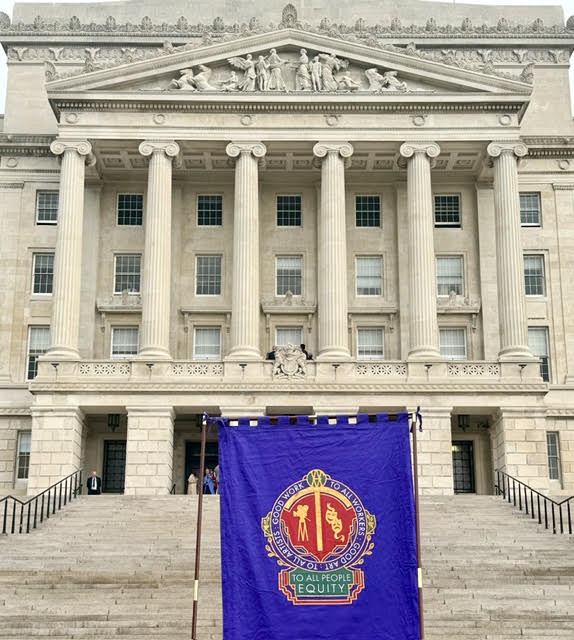
For background, you can read my previous article for Arts Professional on the history of funding cuts to the arts sector in Northern Ireland HERE.
Gordon Lyons has been Minister for Communities for two years. It is the department responsible for the arts since Government closed the Department for Culture, Arts and Leisure in 2016.
When appointed, the Minister set out his position in a Letter of Expectation issued to the Arts Council. This ‘Letter of Expectation’ could be interpreted as a disguised attempt at a ‘Letter of Direction’. His Letter of Expectation outlines that; the Council’s actions would be monitored on an on-going basis, its budget would remain under review, approval of the Arts Council’s strategy would be delayed and new investments by the department should be dedicated to specific areas it defines for spending. All these ‘expectations’ continue to be the case today, two years later, further affirming any interpretation of them as directions. The letter also added the Arts Council should more strategically align its public messaging with that of the Minister. The Arts Council has done so by sharing the Department’s response to the recent protest, causing much anger within the sector. More on this later.
Letters of Direction are meant to be used sparingly. They have become more common since the Covid pandemic, where their use was warranted to deliver immediate, effective public relief. They offer a Minister the power to deliver explicit notices of direction to an agency in their remit, avoiding any arms-length principle. Shifting the definition from ‘Letter of Direction’ to ‘Letter of Expectation’ is a political magic trick. The Arts Council has no option but to accept the terms of the letter, yet they are also not being told they’re directed to do so.
At the protest on 8th September, the Minister descended the steps of Parliament Buildings to meet media and those protesting. He answered questions in political fashion – he stated he wants to help, and would if it were not for the continued disagreement over a Northern Ireland budget. He spoke of his increased support for young farmers, for the homeless. This kind of political spin is dishonest and incredibly frustrating. We need to be clear – the state of Northern Ireland’s current budget has little bearing on the continued, intentional cuts to the arts sector over the past 10+ years. Neither does it bear any relevance to the Minister’s, nor his party’s (the DUP), position on the Arts.
After the protest, his Department for Communities swiftly issued a statement on social media. The Arts Council of Northern Ireland shared it. Many in the arts sector expressed shock and anger the Arts Council itself was now so constrained by the political intentions of Lyons it was no longer representative of the sector’s interests.
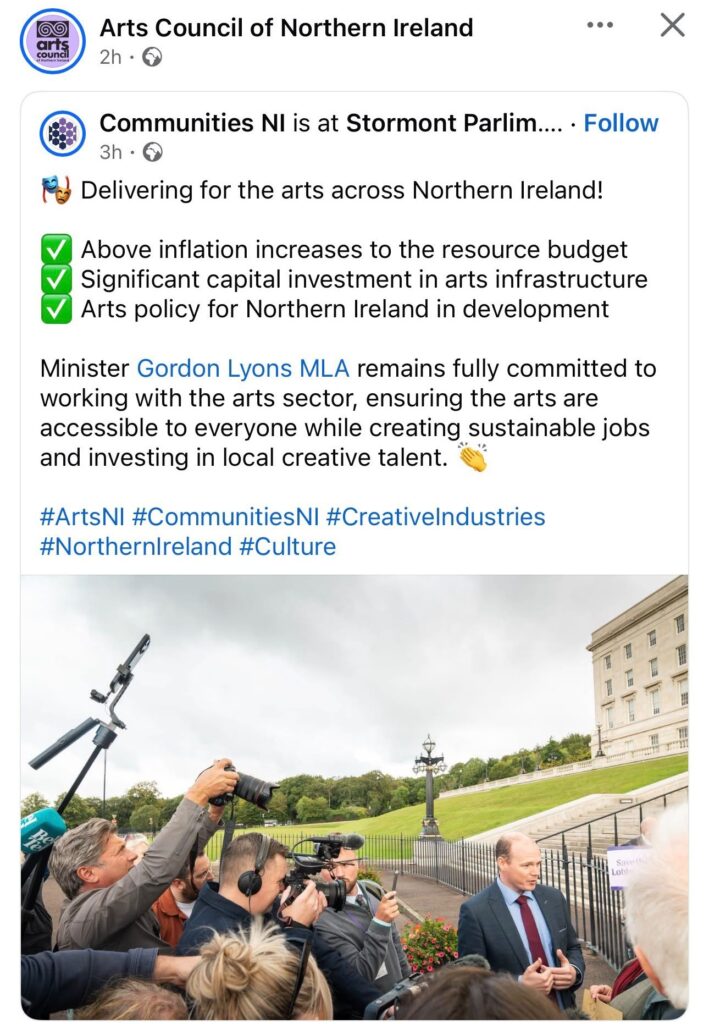
‘Above inflation increases to the resource budget’ – Whose resource budget?
‘Significant capital investment in arts infrastructure’ – What infrastructure?
‘Arts policy for Northern Ireland in development’ – Delayed for what reason?
None of these statements resolve the fact the contemporary arts sector in Northern Ireland has been continuously de-funded and disinvested in to a point of near ruin for more than a decade. It is more political double-speak.
The ‘resource budget’ refers to a minor increase in funds to the Arts Council’s New Small Grants programme. It supports work in harder to reach communities. It is obvious to see its political importance – supporting communities that favour the political base of our main political parties. It is not something that resources a thriving contemporary arts sector.
The ‘capital investment in arts infrastructure’ is money allocated in the Minister’s Letter of Expectations – investing in an expanded programme of musical instruments and travel awards for bands. Our equality legislation does require making this money available to all musicians but this investment is largely supporting traditional musicians and marching bands. Again, something politically advantageous to the Minister but not the wider contemporary arts ecology.
An ‘arts policy’ is ‘in development’ because Gordon Lyons MLA has not agreed to it. It is delayed by his re-drafts and compounded by his lack of approval of the Arts Council’s ten-year strategy, which is itself the product of a consultation with the arts sector.
Government had a public consultation on a culture and arts strategy in 2015-2016 but never published one. Northern Ireland’s executive has not had a published arts strategy since its first in 2001, 25 years ago. Titled Face to Face, it was part of the ‘A Shared Future’ agenda of Northern Ireland’s first peace-time government.
The defences offered by the Department for Communities are irrelevant to what last week’s protest was about and irrelevant to the state of government funding and investment into Northern Ireland’s contemporary arts sector today.
It is clear the protest’s chant of ‘Save the Arts’ is not being listened to by the Minister or his Department. It is disingenuous, at the very least, for the Minister and his civil servants to state the Department has increased investment for the sector and is developing an arts policy. He has done the exact opposite.
Worse still, the Arts Council has been sheared of any advocacy, power or authority to speak confidently on behalf of the sector. The sector is no better off than before Lyons’ appointment. It is demonstrably worse off and now without a strategic vision for the future.
A vibrant arts sector thrives on original ideas and a dynamic and free civic society. The vibrant Northern Ireland we have today is in no small part because of the artists and their peers who attended the march on the morning of Tuesday 8th September at Stormont. A new peace-time Northern Ireland they helped create has broadened the horizon of how we want to live together today. It is clear the political establishment are afraid of this. It threatens an end to their political interests born of conflict and division.
Gordon Lyons actions since his appointment as Minister for Communities, along with his lack of understanding when he met those protesters, must evidence he has no vision for a contemporary arts sector in Northern Ireland. The issue of de-funding and disinvestment in the arts is bigger than him, of course, but his actions have had dire consequences for a sector already beaten to its knees by a creatively myopic series of governments for the past two decades. Gordon Lyons must resign.